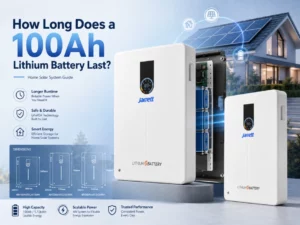
The 100Ah label is only a starting point when a homeowner asks about backup hours. Voltage, usable depth of discharge, conversion loss in the inverter, and the appliances running at that moment all change the answer. A compact 12V unit and a 48V or 51.2V storage unit can carry the same Ah label while belonging to different system designs.
This distinction is easy to miss in a product comparison. Equal amp-hour ratings do not mean equal stored energy. The practical home-solar comparison is the kWh the inverter can use against the demand of the loads that need to remain powered.
Why Doesn’t a 100Ah Lithium Battery Have One Fixed Runtime?
Ah Tells You Charge Capacity, Not the Whole Energy Story
Amp-hours state how much charge is available. Battery voltage is the second value needed to turn that charge rating into stored energy.
The nominal energy relationship is:
Battery energy (Wh) = battery voltage × battery capacity (Ah)
For 100ah lithium battery capacity, read the Ah figure with its voltage. At nominal 12V, 100Ah is about 1.2kWh. A 12V-class LiFePO4 battery often uses 12.8V nominal, giving about 1.28kWh. Use the voltage on the specification sheet rather than an assumed value.
Jarrett’s JREK-48100 is specified at 48V and 100Ah, so its standard energy is 4.8kWh. JREK-51.2100 is specified at 51.2V and 100Ah, or 5.12kWh. Those ratings put a 100ah lithium battery 12v setup in a different comparison group from a 48V home-storage battery.
Residential buyers can compare voltage and capacity in the Jarrett lithium battery range before matching storage with the rest of the system.
Usable Energy Is Lower Than Nominal Energy
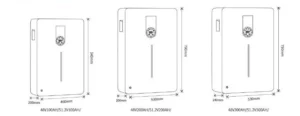
The full nameplate value is not the energy normally budgeted for runtime. A recommended DOD window leaves a reserve instead of cycling the battery from full to empty.
Jarrett’s JREK Power Wall models specify a suggested 80% DOD. Applying that limit to the 4.8kWh JREK-48100 leaves about 3.84kWh before inverter losses; the 5.12kWh JREK-51.2100 leaves about 4.10kWh.
Use this reduced energy figure in a practical 100ah lithium battery run time estimate.
How Do You Calculate 100Ah Lithium Battery Run Time?
Start With Usable AC Energy
For an appliance supplied through an inverter, estimate runtime with:
Runtime (hours) = nominal battery energy × usable DOD × inverter efficiency ÷ average AC load
Use the inverter efficiency reported for the load under review. Efficiency changes with operating point, so one percentage should not be copied to every case.
For a worked example, take a 48V 100Ah battery with 4.8kWh nominal energy, 80% DOD, and 90% inverter efficiency. The available AC energy is:
4.8 × 0.80 × 0.90 = 3.456kWh
At 300W the result is about 11.5 hours; at 500W it is about 6.9 hours; at 1,000W it is about 3.5 hours.
These figures help with sizing, but they are not guarantees. Refrigerator cycling, pump startup surges, changing household demand, and inverter consumption all affect the field result.
Build the Estimate From a Load List, Not One Appliance
Several household devices normally operate together. During an outage, list the loads that must stay on instead of sizing around a refrigerator by itself.
| Essential load | Example planning load |
| Refrigerator and controls | 100W average |
| Router and networking | 20W |
| LED lighting | 60W |
| Laptop and home office | 100W |
| Fans or small household loads | 120W |
| Total average load | 400W |
Using the illustrative 3.456kWh of AC energy, the 400W average load gives roughly 8.6 hours. A 1,500W appliance used for part of that interval consumes the reserve much faster.
A load list ties 100ah lithium battery run time to this household, making the estimate useful for system sizing.
What Can Shorten Runtime in a Real Home Solar System?
Stored Energy and Instantaneous Power Are Different Limits
Stored energy is only one limit. A battery may last for hours but still lack the current or inverter power needed to start a high-power appliance.
The JREK-48100 and JREK-51.2100 each specify 100A standard discharge current. Select the inverter for AC output, battery voltage, load behavior, and operating mode, and review its kW rating with the battery kWh rating.
Jarrett’s off-grid hybrid inverter options can be compared with the battery specifications during solar-storage configuration.
Temperature and Installation Conditions Still Matter
JREK 100Ah models specify -20°C to 60°C for discharge and 0°C to 45°C for charging. Their IP21 rating also makes the installation location part of the design.
The installation review still covers ventilation, cable sizing, overcurrent protection, enclosure conditions, and the manufacturer’s operating limits. A runtime calculation cannot replace these checks.
How Long Does a 100Ah Lithium Battery Take to Charge?
Charge Current Gives a Useful First Estimate
A first charge-time estimate uses:
Charge time (hours) ≈ battery capacity (Ah) ÷ charging current (A)
Jarrett specifies a 50A standard charge current for both JREK-48100 and JREK-51.2100. With an ideal constant-current assumption, 100Ah divided by 50A gives about two hours.
In service, 100ah lithium battery charge time may be longer. Charger output, BMS behavior, available solar power, temperature, and starting state of charge all contribute.
Starting at 50% state of charge leaves less energy to replace than starting much lower. That can determine whether the PV array restores the battery before evening demand arrives.
Why Can’t You Calculate Solar Charging From Sunshine Hours Alone?
Panels do not send every generated watt into the battery. During daylight, household loads may consume part of the PV output first.
If daytime loads use most of the solar production, less remains for charging. A larger surplus can recharge faster, while shading, panel orientation, weather, MPPT operation, and inverter/charger limits narrow the charging window.
Consider 100ah lithium battery charge time with PV array size, charger capability, and the home’s daytime consumption profile.
When Is One 100Ah Battery Enough for a Home?
Start With the Backup Window You Actually Need
A single 100Ah battery can cover a defined essential-load group for a limited period. It may be undersized when electric cooking, water heating, large air conditioners, pumps, or a long overnight outage are included.
Before choosing capacity, answer three questions:
- Which loads must remain powered?
- What are their realistic average and peak power requirements?
- How many hours of backup are required before solar or grid charging becomes available?
Then calculate the energy requirement from those answers.
For example, 500W of essential loads over eight hours requires about 4kWh of AC energy before design margin. That requirement places a 100ah lithium battery 12v and a 5.12kWh 51.2V battery in different system categories.
What If the Home Needs More Capacity Later?
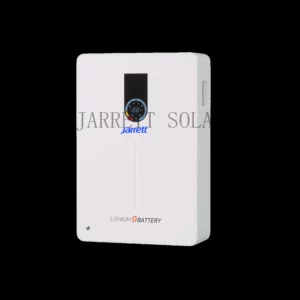
The Power Wall LFP Energy Storage Battery range includes 48V and 51.2V models from 100Ah to 300Ah.
The 100Ah models provide 4.8kWh or 5.12kWh standard energy. The 200Ah versions provide 9.6kWh or 10.24kWh, and the 300Ah models provide 14.4kWh or 15.36kWh. The JREK series supports up to 15 units in parallel.
To add capacity, choose a larger battery or plan a parallel bank. Inverter compatibility, present demand, installation space, and future energy use determine the better route.
Planning the expansion early keeps the first battery purchase aligned with future system needs.
How Should Buyers Match a 100Ah Battery With an Inverter?
Check Voltage Before Looking at Extra Features
Check voltage before comparing features. A 100ah lithium battery 12v cannot replace 48V or 51.2V storage merely because all have a 100Ah label.
JREK-48100 has a 40.5V to 54V working range; JREK-51.2100 has a 43.2V to 57.6V range. Compare those values with the inverter’s supported battery range and charging settings.
Communication is another compatibility check. Both models specify RS232/CAN and an LED/LCD display. The inverter must support the required electrical and communication arrangement, not just the target AC wattage.
What Should You Verify Before Ordering?
Before ordering, verify:
- nominal battery voltage and working-voltage range
- nominal kWh rather than Ah alone
- recommended DOD
- standard charge and discharge current
- inverter battery-voltage compatibility
- communication protocol
- household average and peak loads
- required backup duration
- PV energy available for charging
- installation environment and IP rating
- future parallel expansion
Jarrett supplies batteries, solar modules, controllers, and inverters, plus consulting, design, and system-integration support. The JREK models specify a five-year warranty and CE/ROHS certification. For a broader installation, review Jarrett solar system solutions and size storage around the complete electrical design.
Conclusion
A 100Ah battery may cover a few hours or much longer, depending on the surrounding system. Voltage determines the energy represented by 100Ah; usable DOD, inverter losses, and household demand determine the rate of use. Convert 100ah lithium battery capacity to kWh before estimating runtime.
For home solar, calculate required AC energy first. Then confirm battery voltage, inverter compatibility, and charge/discharge limits before choosing one battery or an expandable bank.
Jarrett’s 48V and 51.2V JREK 100Ah models start at 4.8kWh and 5.12kWh. Larger capacities and parallel expansion are available when the design needs more storage.
If you already know your critical loads, required backup hours, inverter model, and PV array size, discuss your battery and inverter configuration with Jarrett before finalizing the system.
FAQs
Q1: How long will a 100Ah lithium battery run a 500W load?
A1: Use battery voltage, usable DOD, and inverter efficiency in the calculation. In the 48V 100Ah example, 4.8kWh nominal energy becomes about 3.456kWh usable AC energy at 80% DOD and 90% inverter efficiency, or roughly 6.9 hours at a steady 500W load. Actual runtime depends on the site.
Q2: Is a 48V 100Ah battery the same capacity as a 12V 100Ah battery?
A2: No. A nominal 12V 100Ah battery works out to about 1.2kWh, while a 48V 100Ah battery works out to 4.8kWh. The Ah label matches; the stored energy does not. Include voltage in the comparison.
Q3: What affects 100ah lithium battery charge time in a solar system?
A3: Charging time depends on starting state of charge, charger current, PV energy left after daytime loads, BMS control, temperature, and inverter/charger limits. A current-based estimate helps planning, but the solar system must supply the energy under real conditions.