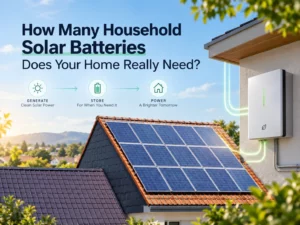
There is no standard battery count that applies to every home. The required bank follows the system purpose, the energy drawn by the selected circuits, the length of support required, and the rate at which the solar array can restore that energy. Start with usable kWh rather than unit count; otherwise the installed storage can be excessive or the backup window can fall short.
Work from the backup objective to usable energy, then test peak demand, battery voltage and current against the inverter, and finally confirm that the PV system can recharge the bank. That order also shows whether a single larger battery or a bank that can grow later fits the project.
What Should You Decide Before Counting Batteries?
Are You Sizing for Evening Use or Outage Backup?
A home that only wants to move daytime solar into the evening has a different storage target from a home preparing for an overnight outage. A third case is whole-home backup, where larger appliances may need to remain available for many hours.
For solar batteries for home, start by deciding what the batteries must actually do. If the goal is evening self-consumption, look at the energy normally imported after sunset. If the goal is backup, list the circuits that must stay on and how long they need support. If the home should continue operating almost normally during an outage, both battery capacity and inverter output need to increase.
This first decision prevents a common sizing problem: using the home’s entire daily electricity consumption even when only a smaller group of essential loads needs battery power.
Which Loads Actually Need Battery Power?
Create a short load list instead of guessing from a monthly utility bill. Essential circuits often include refrigeration, lights, internet equipment, office devices, pumps, and selected sockets. Water heaters, larger air conditioners, ovens, and EV charging can raise the requirement sharply.
For each circuit, note average watts, any relevant startup or surge demand, and planned operating hours. For example, 100W operated for ten hours consumes 1kWh. A 2kW appliance used for 30 minutes consumes the same 1kWh. Their energy totals match, but the system sees very different instantaneous power demands.
A home battery storage system therefore needs an energy calculation and a power calculation.
How Do You Convert Household Loads Into Battery Capacity?
Start With Usable Energy, Not Nameplate Energy
Suppose the essential-load list averages 600W and the target backup window is eight hours. The AC loads require about 4.8kWh before reserve capacity and conversion losses are considered.
Battery nameplate capacity is not the same as the capacity normally planned for use. Jarrett’s JREK Power Wall models specify a suggested 80% depth of discharge. For example, the 5.12kWh JREK-51.2100 provides about 4.10kWh when 80% of nominal energy is used as the planning window, before inverter losses are included.
This is why household solar batteries should be compared in kWh and usable operating range, not only in Ah.
Buyers can compare 48V and 51.2V options in the Jarrett lithium battery range before selecting a capacity.
Separate kWh From kW
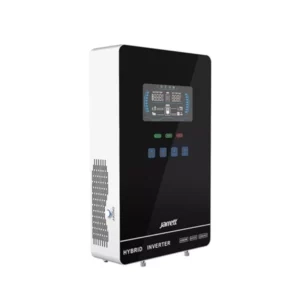
Battery kWh answers “how long?” Inverter kW and battery discharge capability answer “how much power at once?”
A bank may store enough energy for the night but still be poorly matched to a high simultaneous load. Imagine a refrigerator, pump, kettle, and air conditioner operating close together. The stored energy may be sufficient, while the instantaneous current is much higher than a simple runtime calculation suggests.
For a home solar battery system, run two separate checks.
For energy, multiply the average load by backup hours, then allow for usable DOD and conversion losses.
For power, confirm that inverter output, battery discharge current, and surge capacity can handle loads that operate together.
Separating those checks prevents a storage bank from being enlarged when the actual limit is power delivery.
How Many Batteries Do 5, 10, or 15 kWh Requirements Translate Into?
Jarrett’s Power Wall range is useful for understanding how a calculated storage requirement maps to real battery sizes. At 48V, the listed nominal energy is 4.8kWh for 100Ah, 9.6kWh for 200Ah, and 14.4kWh for 300Ah. The equivalent 51.2V versions list 5.12kWh, 10.24kWh, and 15.36kWh.
| Battery configuration | Nominal energy | Suggested DOD | Standard discharge current |
| 48V 100Ah | 4.8kWh | 80% | 100A |
| 51.2V 100Ah | 5.12kWh | 80% | 100A |
| 48V 200Ah | 9.6kWh | 80% | 100A |
| 51.2V 200Ah | 10.24kWh | 80% | 100A |
| 48V 300Ah | 14.4kWh | 80% | 150A |
| 51.2V 300Ah | 15.36kWh | 80% | 150A |
Those sizes are examples of available configurations, not a rule that a small home requires 5kWh or a larger home requires 15kWh. The required size still comes from the load calculation. The table shows how an energy target can translate into different real battery configurations.
The Power Wall LFP Energy Storage Battery supports up to 15 units in parallel, so a system can begin with the required capacity while leaving room for later expansion.
Can Your Solar Array Recharge the Battery Bank Every Day?
Calculate Solar Surplus, Not Total PV Production
A larger battery bank only helps if the available energy source can refill it within the required time. This is where many home solar system with battery storage calculations stop too early.
For instance, an array may produce 20kWh on a strong solar day while the house uses 14kWh before sunset. The battery does not automatically receive 20kWh. The useful starting point for charging is the surplus left after daytime consumption, before charging and conversion losses are considered.
For a home solar battery system, compare the energy removed from the battery overnight with the realistic solar surplus available the next day. Where the daytime surplus stays low, a much larger bank may take longer to recharge and contribute little to the usual daily cycle.
Weather, shade, season, panel orientation, and household use patterns all change the available surplus. Base the design on representative production rather than the strongest solar day of the year.

Check Charge Current and Inverter Limits
Available solar energy is only part of recharging. The inverter or charger also has a maximum battery charging capability.
Jarrett’s JREK 100Ah models specify a 50A standard charge current, while the 200Ah models specify 100A and the 300Ah versions 150A. The inverter or charge controller should be selected around both the battery-bank voltage and the permitted charging current.
This is why Jarrett’s off-grid hybrid inverter options should be reviewed together with storage. In a properly matched home battery storage system, PV input, inverter output, battery voltage, charging current, and battery capacity all support the same operating goal.
A home with enough storage for two nights but only enough surplus PV to recover a small part of that energy each day needs a different design from a home that can refill the battery before sunset.
Is One Larger Battery Better Than Several Smaller Batteries?
Compare More Than Total kWh
Two battery arrangements can carry similar total energy while behaving differently in the system. One larger battery can simplify the physical layout. Multiple smaller units can offer a more modular route when capacity will be expanded in stages.
Current limits, communication, available installation space, protection devices, cable layout, and inverter compatibility should all be included in the comparison. Jarrett’s JREK series uses RS232/CAN communication, and all six Power Wall models support up to 15 units in parallel.
For solar batteries for home, the better arrangement is the one that meets today’s loads without making tomorrow’s expansion difficult.
This is also why a simple “number of batteries” recommendation can be misleading. A single 300Ah unit and three 100Ah units do not automatically create the same system merely because the nominal Ah total is similar. Charge current, discharge capability, wiring, protection, communications, and physical installation still require review.
Plan Expansion Before the First Battery Is Installed
Future loads are easy to overlook. A household may later add a larger air conditioner, pump, home office, workshop equipment, or EV charging. Storage may also need to cover longer outages.
If expansion is likely, make sure the inverter, DC protection, cables, busbars, communication arrangement, and physical installation can accommodate the planned battery bank. A home solar system with battery storage is easier to grow when the first installation already has a clear expansion path.
Jarrett supplies lithium batteries together with solar modules, controllers, and inverters, and supports photovoltaic system consulting, design, integration, installation, and commissioning. This allows storage to be planned as part of the wider electrical system rather than as an isolated component. Buyers can review Jarrett photovoltaic solutions when combining new storage with a solar installation.
How Should the Final Battery Size Be Checked Before Ordering?
Before ordering household solar batteries, run the design through four questions.
First, does the usable kWh cover the required backup window? Second, can the battery and inverter supply the highest realistic simultaneous load? Third, can the PV array and charger replace the energy used within the required recharge period? Fourth, can the system expand if household demand grows?
Then check the detailed electrical fit: battery working voltage, charge and discharge current, communication method, inverter compatibility, installation environment, and parallel limit.
Jarrett offers the Power Wall range in 48V and 51.2V versions at 100Ah, 200Ah, and 300Ah. It uses Class A LiFePO4 cells, specifies over 6000 cycles at 80% DOD, provides RS232/CAN communication, and carries a five-year warranty with CE/ROHS certification.
For buyers planning a complete home solar battery system, this product range creates several ways to reach the required storage target rather than forcing every household into one fixed battery size.
If your load list, inverter model, PV capacity, and required backup hours are already known, discuss your storage configuration with Jarrett before finalizing the battery quantity and system configuration.
Conclusion
Floor area and household size do not by themselves establish the required number of household solar batteries. First define the energy that must be covered, then convert it to a usable-kWh target. Then verify inverter power, battery current, solar recharge capability, and the expansion route.
A 5kWh-class battery may fit a tightly defined essential-load plan. A 10kWh or 15kWh-class system may suit longer backup periods or higher daily energy demand. Multiple batteries can become the better route when storage needs are expected to grow.
The useful question is therefore not simply “How many batteries should I buy?” It is “What battery system can support my loads, recharge reliably, and still fit the way my home may use energy later?”
FAQs
Q1: How many solar batteries for home backup are usually needed?
A1: There is no universal number. Calculate the energy used by the selected backup loads, multiply it by the required operating hours, then account for usable DOD and conversion losses. The resulting kWh requirement can then be compared with the usable capacity of the selected battery model.
Q2: Is a 10kWh home battery storage system enough for a house?
A2: It can be enough when the selected loads and required backup period fit within the usable energy available. High-power appliances still require a separate check of inverter output and battery discharge current, so a 10kWh capacity figure alone does not determine whether the complete system is suitable.
Q3: Can a home solar system with battery storage be expanded later?
A3: Yes. Expansion works when the battery platform, inverter, protection devices, wiring, charging capacity, and communication arrangement are designed for it. Jarrett’s JREK Power Wall series supports up to 15 batteries in parallel, giving the system a clear route for future storage expansion.